Picture This Qoute

You Inc.


People don’t plan to fail they just don’t plan to succeed.


If you wish to create a great business, you must start with writing a business plan. A plan that comprises of the business: vision, mission, values, mantra, logo, strategies, market and many more. It is a daunting work involving a lot of thinking, analysis, and experimentation. Although, creating  a great business will result in giving you financial independence, prestige, and social standing, you may end up unhappy about the whole experience at the end. The reason is that there is one thing that you really need to do during the process, that is creating yourself: You Inc. Work gives meaning to our life, but what if you feel that your work is useless. What happens if you spends your entire life doing something and you ultimately looks into the mirror and don’t see yourself in there. Thus, just as it is important to plan a business it is more important to plan to create yourself.

More into this later

The Experimenter

" When I was young I observed that nine out of every ten things I did were failures, so I did ten times more work” ~ George Bernard Shaw


Regardless how hard you try, you will always fail at something. That's why, your attitude toward failing shall be postive in order for you to succeed in accomplishing your bigger dreams. Author John Maxwell called this "Failing Forward", Enistien said "Anyone who has never made a mistake has never tried something new", and many successful business men and women have gone broke, some of them many times, before they made it big.

In my openion, there are three traits you must have in order to turn failures into building blocks for huge success
  1. The experimenter attitude: you must treat every initative as an experiment. Experiments are called experiments because they could fail when they fail, they are after all experiments. Experiment are easier to abondon, easier to get over, and no one can be blamed when things go south. 
  2. The experimenter ego, many people want to look infallible. No doubts, we never want to look bad in front of others. But, in this age a full mark put you behind a desk while mistakes make you the boss. So enjoy failure, take picture of them, and laugh at them later on. Just stay away from high risk experiments.
  3. The experimenter knowledge wisdom, experimenters know they don't know everything thus they are working on learning and achieving at the same time. Edison, failed forward toward the light bulb and then he lighted the whole world.

Changing Managing Change

Many people try in vain to change something in them, they fail and yet they repeat the same method they were using or just quit trying. When you try to change yourself, you feel that everything is conspiring against you and believe it or not, it is. Because you are a social creature and we move in groups and thus we depend a lot on our surroundings. Then to change,you must start with changing the conditions around you not yourself. If you want to lose weight then ask your spouse and\or your close friends to join you in a group diet. If you want to develop a skill, join like-minded people who are trying to develop the same skill. For example, Toastmasters clubs put speakers together to develop their public speaking skills. One reason why speed runners do not break records during practice even though they are relaxed and stress-free is that they are relaxed and stress-free, the surrounding conditions are not enough. You have to choose your comparators, your enemies and make them close and make them turn you into what your family and friends couldn’t do.

Excellence Ecosystem

"You cannot change everyone around you but you can choose those who are around you."

Sometimes, we feel tired, our efforts are futile, and the world is just a bad place to be in. If you ever felt that way, it is because of the environment you are in not the WHOLE world. Jim Collins, Author of the best seller book “Good To Great” spoke of his method for people to find themelves by asking the following four questions:

1-     List all the things you are great at or can be great at?

2-     From the previous list, highlight the things that people will pay you to do.

3-     Then from the previous list, highlight the one you are most passionate about?

4-     Finally, choose whom you will work with or where you will do what you got from the final list.

You might be doing what you are great at and passionate about, and being paid to do it,  but you fail because you are in the wrong ecosystem. What to do if you are in a bad place varies depending on your authority level as you maybe be a decision maker, or influencer, or neither of both. The good thing is that motivation is contagious and if you start from your end you will definitely improve your environment but if you are certain that your environment will never change, then it is your responsibility to change your place even with a little loss.  It is your life, temporary losses are what stopping many people from winning big,and by that they lose themselves in the way.

Dream Big

"Dream no small dreams for they have no power to move the hearts of men"

Everyone has a dream and if he or she doesn’t. Your mission as a leader for others and leader of yourself is to make him, or her, or yourself have one and believe in achieving it. Dreams are good for people psychological health. Moreover, If they shall have dreams, they shall as well make their dreams big. The bigger the dream, the better the glory.

Everyone has the right to be successful in having and pursuing his dreams for it is basically humans necessity.


Creativity is a Joke II

Is a creative solution to a difficult problem nothing but a joke?

To get us started, consider the following joke: a group of armed robbers burst into a bank, line up customers and staff against the wall, and begin to take everything from them. Two of the bank’s accountants are among those waiting to be robbed. The first accountant suddenly gets something out of his pocket and put it in the other accountant's hand. The second accountant whispers, “What is this?” and The first accountant replied, “It’s the 100 bucks I owe you.

This is funny but it is also very smart and creative solution.

Jokes like these made me realize that creativity and humor have a lot of common. I now believe that a creative solution or let say break through is nothing but a physical joke. Both require a transition between two meanings by a connection point.

 To illustrate and prove my point, let take an example of each and analyze it:

 First the joke:
Sam walks into his boss’s office and say. “Sir, I’ll be straight with you, I know the economy isn’t great, but you know how smart and hard worker I am. In face, I currently have over three companies after me, and I would like to respectfully ask for a raise.”
After a few minutes of thinking the boss finally agrees to a 5% raise.
Sam happily gets up to leave. When his boss asked: “By the way” “which three companies are after you?” Sam said: Well they are “The electric company, Water Company, and Phone Company” are after me to pay their bills.

If you analyze the joke you notice that it starts with something we are all familiar with. Then, there is a buildup before the punch line is reached. The punch line is what makes us laugh and it is usually a connection with another meaning that was not unexpected.


The connection point in the last joke are the words "after me" which is subject to misinterpretation or right interpretation.

Now let's take a creative solution example:
The people who invented the food can opening method got their idea from somewhere completely unrelated, or at least seem unrelated.

 They imitated the "opening" of a banana


Here the connection point is the word “open”.
We have an unsolved problem: A can needs to be opened.
We know a seemingly unrelated solved problem: We know how to "open" a banana. Why not open the can like a banana. Problem is solved.

The English writer William Plomer once said “Creativity is the power to connect the seemingly unconnected".

One profound similarity is the environment: when you tell a joke you must consider the time, the place and the people hearing the joke. You would not tell a joke in a funeral, nor tell a stereotype joke to people affected by the stereotype. Also, a creative idea has its time, place, and people.

Consider the following, a company called "Design that Matter" knew that millions of children in the developing world die each year because they we are born in a place that lack new born incubators. Buying incubators from the market and shipping them there is not a feasible solution because they are very expensive and if it breaks there is no one who can fix it. In one particular area,  they asked a "connection" question? What do these people have in abundance? What have they solved already?
They noticed that there are many Toyota Forerunner everywhere and it seems that these people have the spare parts and the skills to maintain these cars running. So they designed incubators completely from that car spare parts. Problem is solved and millions of children are saved.

Einstein famously said that "a problem cannot be solved in the same mindset that created them". You know now what he meant. You have got to look for seemingly unrelated connection.

Consider how David's mother used what she knew to solve her son's challenge in the following joke:

 So David Is finally engaged, and is excited to show off his new bride:
 “Ma”, he said to his Mother, “I’m going to bring home three girls and I want you to guess which one is my fiancĂ©.”
 Later, David walks in the door with three girls following behind him.
“It’s that one”, said his mother.
 without blinking an eye.
 David shouted “how in the world did you know it was her?”
She said: I just don’t like her.

David's mother knew that mother in law don't usually like their son’s wife so she picked the one she didn't like.

In conclusion humor and creativity have the same structure, environment and require a connection between two meanings. That's why I think they are just two faces of one coin.

On being a Toastmaster

The last time I attended a Toastmasters club meeting, a fellow toastmaster asked a question:

Why are we here in toastmasters? 

He then answered that we are here to improve our communication and leadership skills.

Since I am interested in philosophy and psychology, I thought his answer wasn’t sufficient. Despite that it is the right answer because that was what toastmasters program is intended to do.

Therefore, I will now tell you, why I go to toastmasters club meetings by answering another question: why do we do anything at all?

Twenty four hundred years ago Aristotle said:
"Happiness is the meaning and the purpose of life; it is the whole aim and the end of human existence”.

Although people may pursue money, fame, social status and everything else, they do it because they believe that will make happy. Afterlife believers, including myself, believe that our aim is to obtain an eternal happiness, a type of happiness that transcends this life to the afterlife.

In the other hand, lack of happiness can lead people to lose their minds, commit crimes and end their own lives. Thus, your happiness is a serious matter and whether you know it or not, you are driving yourself crazy to put a smile on your face. Do you know how to obtain happiness or are merely stumbling on it every now and then?

A lot has been said about happiness, and you will hear it defined differently from different people. Some think that happiness is financial success but we have heard of some wealthy successful people end up using drugs, taking depression bills, or committing suicide.

Others believe that happiness is contentment and we hear them saying something like "happiness is not getting what you want, but wanting what you already have". This is Nonsense because there is a thin line between being content and being complacent and your complacency could stop you from becoming the person you want to be and when you are old, you will reflect sadly of what you could’ve been.

Me: OH Aristotle, it has been 2400 years and we don't seem like we are any closer to understand the purpose of life. Can you help us?

Aristotle: Yes my dear, Happiness is the perfection of human nature.

Me: Perfection of human nature: What does that even mean?

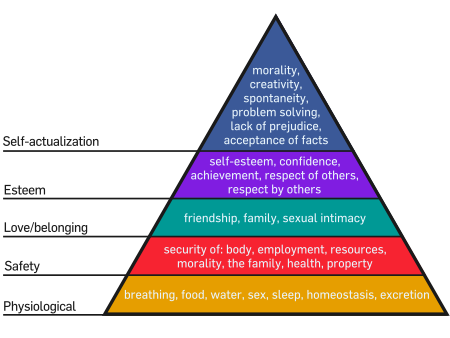
In my opinion, there is one person who had an excellent theory of human nature and thus knew happiness well to articulate Aristotle definition of happiness: that is the psychologist Abraham Maslow. Maslow said that inside each one of us, an essential biological inner natural that’s intrinsic, given, and in a certain limited sense unchangeable. He summarized his idea in a theory famously known as the hierarchy of needs.

As human beings there are five levels of needs that at every moment of time we are trying to fulfill one or more. At the bottom of this hierarchy there are our physiological needs: the need to breath, eat, drink, sleep and anything related to our bodies and they come as the highest priority for us to fulfill.

Then there are safety needs: where we seek employment, protection, and stability.

The next level is the social needs: where we begin to feel the need to belong, the need for friends, a lover, and a community.

The forth level is the need for self-respect and self-esteem: this level involves the need for the respect of others the need of status, fame, appreciation and recognition. This level also involves the need for self-respect by having feelings as confidence, sense of achievement, independence and freedom.

The final level of the hierarchy of needs is the level of self-actualization where we try to fulfill every potential to become our ultimate-self. This is our essential inner nature and perfecting it is what Aristotle thought of happiness.

We live in the age of the upper two levels: the level of self-esteem and self-actualization. Therefore, If we were starving to death, or in an unsafe environment, or we don’t belong to a community. We wouldn’t be in toastmasters and we would be fighting to get our highest priority needs.

We attend toastmasters meeting to get the respect of others and ourselves and to become the best we can be.

In conclusion, happiness is driving our lives like we drive our cars, taking us places and making us do what we do at every moment of time.