Picture This Qoute

Showing posts with label Happiness. Show all posts

You Inc. III

"All humans are strategic by nature, they all think they are doing what's best"

Many life coaches will advise you not to read a step-by-step self-help book. The reason is that the way someone else took to succeed may not be your way. Thus, in your personal plan you must have your own strategies, habits, and execution plan.

6- Strategy:You must understand that there is a difference between strategy and tactics. Strategy is how to achieve an objective while a tactics is what, not a how, to achieve an objective. Say your objective is to utilize your time to the minute, your strategy could be to avoid distraction or to increase concentration, Your tactics, in the other hand, could be to utilize your driving time to listen to an audio book that you wish to read.
You must consider your strengths and capitalize on them and be honest about your weaknesses and alleviate them.

7- Habits: These are the habits you must habituate yourself to in order to have the character you envision yourself as. You really don't need to invent you own habits because success habits are common. You could begin by applying Steve Covey's book, The 7 Habits of Highly Effective People:
  • Be proactive: Take charge of your life.
  • Begin with End in Mind: Envision success to achieve it.
  • Put First things First: Manage your time effectively.
  • Think Win-Win: Choose whom to work with and make everyone wins.
  • Seek First to Understand, Then to Be Understood: practice effective communication.
  • Synergize: Cooperate and be creative.
  • Sharpen the Saw: You are subject to forget and to weaken, thus you must stay motivated, informed, and active.
There are many more success habits, you just need to know that, simply, every habit has a result, good habit leads to good results, and bad habit leads to bad results. You must be aware of your habits: what do you usually do. Keep the good ones and stubtitute the bad ones with good ones. Don't just try to stop bad habits, you must introduce new ones to follow.

One habit I would like to emphasize is to celebrate your victories as well as your failures because your failures are useful to your success. I love a quote that say, "Everything is useful, even useless people can be used as bad example".

8- Execution plan: This is a plan that contains SMARTERS goals. Goals that are:

Letter Major Term Minor Terms
S Specific Significant, Stretching, Simple
M Measurable Motivational, Manageable, Meaningful
A Attainable Appropriate, Achievable, Agreed, Assignable, Actionable, Adjustable, Ambitious, Aligned, Aspirational, Acceptable, Action-focused
R Relevant Result-Based, Results-oriented, Resourced, Resonant, Realistic
T Timely Time-oriented, Time framed, Timed, Time-based, Timeboxed, Time-bound, Time-Specific, Timetabled, Time limited, Trackable, Tangible
E Evaluate Ethical, Excitable, Enjoyable, Engaging, Ecological
R Reevaluate Rewarded, Reassess, Revisit, Recordable, Rewarding, Reaching
S Satisfactory Satisfies Strategic Vision

Finally, writing your personal plan is not enough, it is just the first step. You next step is to actually execute it machanically and revisit it often until it changes from a plan into your actual life.
Good Luck.


This is a continuation to two earlier blogs You Inc., You Inc II

On being a Toastmaster

The last time I attended a Toastmasters club meeting, a fellow toastmaster asked a question:

Why are we here in toastmasters? 

He then answered that we are here to improve our communication and leadership skills.

Since I am interested in philosophy and psychology, I thought his answer wasn’t sufficient. Despite that it is the right answer because that was what toastmasters program is intended to do.

Therefore, I will now tell you, why I go to toastmasters club meetings by answering another question: why do we do anything at all?

Twenty four hundred years ago Aristotle said:
"Happiness is the meaning and the purpose of life; it is the whole aim and the end of human existence”.

Although people may pursue money, fame, social status and everything else, they do it because they believe that will make happy. Afterlife believers, including myself, believe that our aim is to obtain an eternal happiness, a type of happiness that transcends this life to the afterlife.

In the other hand, lack of happiness can lead people to lose their minds, commit crimes and end their own lives. Thus, your happiness is a serious matter and whether you know it or not, you are driving yourself crazy to put a smile on your face. Do you know how to obtain happiness or are merely stumbling on it every now and then?

A lot has been said about happiness, and you will hear it defined differently from different people. Some think that happiness is financial success but we have heard of some wealthy successful people end up using drugs, taking depression bills, or committing suicide.

Others believe that happiness is contentment and we hear them saying something like "happiness is not getting what you want, but wanting what you already have". This is Nonsense because there is a thin line between being content and being complacent and your complacency could stop you from becoming the person you want to be and when you are old, you will reflect sadly of what you could’ve been.

Me: OH Aristotle, it has been 2400 years and we don't seem like we are any closer to understand the purpose of life. Can you help us?

Aristotle: Yes my dear, Happiness is the perfection of human nature.

Me: Perfection of human nature: What does that even mean?

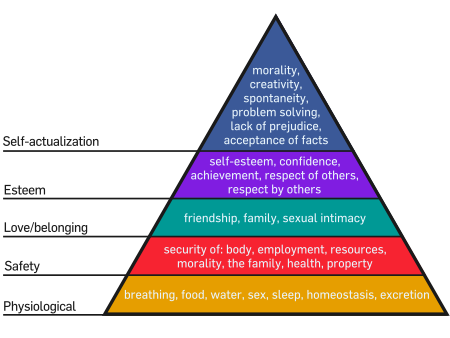
In my opinion, there is one person who had an excellent theory of human nature and thus knew happiness well to articulate Aristotle definition of happiness: that is the psychologist Abraham Maslow. Maslow said that inside each one of us, an essential biological inner natural that’s intrinsic, given, and in a certain limited sense unchangeable. He summarized his idea in a theory famously known as the hierarchy of needs.

As human beings there are five levels of needs that at every moment of time we are trying to fulfill one or more. At the bottom of this hierarchy there are our physiological needs: the need to breath, eat, drink, sleep and anything related to our bodies and they come as the highest priority for us to fulfill.

Then there are safety needs: where we seek employment, protection, and stability.

The next level is the social needs: where we begin to feel the need to belong, the need for friends, a lover, and a community.

The forth level is the need for self-respect and self-esteem: this level involves the need for the respect of others the need of status, fame, appreciation and recognition. This level also involves the need for self-respect by having feelings as confidence, sense of achievement, independence and freedom.

The final level of the hierarchy of needs is the level of self-actualization where we try to fulfill every potential to become our ultimate-self. This is our essential inner nature and perfecting it is what Aristotle thought of happiness.

We live in the age of the upper two levels: the level of self-esteem and self-actualization. Therefore, If we were starving to death, or in an unsafe environment, or we don’t belong to a community. We wouldn’t be in toastmasters and we would be fighting to get our highest priority needs.

We attend toastmasters meeting to get the respect of others and ourselves and to become the best we can be.

In conclusion, happiness is driving our lives like we drive our cars, taking us places and making us do what we do at every moment of time.